

Kelowna, British Columbia— (Newsfile Corp. – April 22, 2026) – F3 Uranium Corp (TSV: FUU) (OTCQB: FUUFF) (“F3” or “the Company”) is pleased to announce encouraging results from its recently completed winter 2026 diamond drilling program at the Tetra Zone on its 100% owned Patterson Lake North (“PLN”) Project in the Athabasca Basin, Saskatchewan.
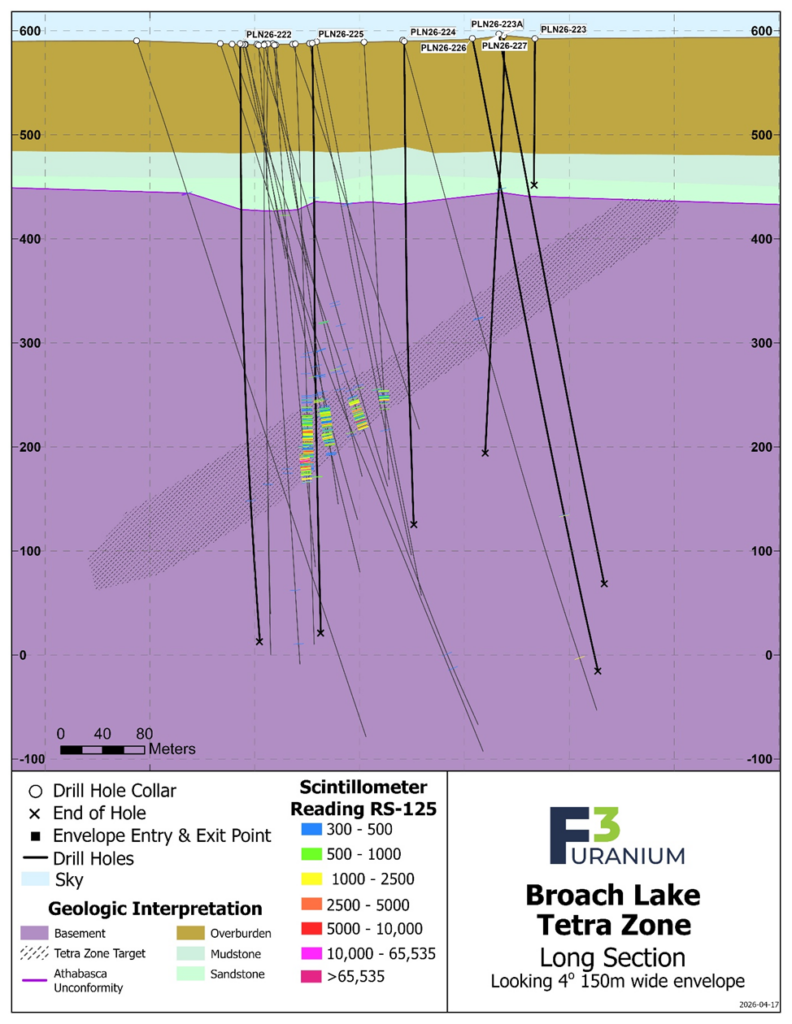
The six-hole step-out program tested extensions of the Tetra Zone along strike and down plunge. Uranium mineralization was successfully intersected in three holes. Highlighting the program, hole PLN26-226 returned 0.5 m of radioactivity up to 1,400 cps (from 470.5 to 471.0 m) 275m along strike from the high grade intersected in PLN25-219A which returned a main mineralized interval of 13.0m of 0.28% U3O8, including three high grade sections with 3.0 m of 1.19% U3O8 from 396.5 to 399.5m (see NR March 31, 2026). Additional intervals of anomalous radioactivity were intersected in holes PLN26-225 and PLN26-222.
These intersections validate F3’s structural model and confirm that the Tetra Zone remains open along strike and down plunge. Importantly, a structural and mineralogical study in combination with age dating strengthens the interpretation that the Tetra Zone is genetically linked to the high-grade JR Zone, significantly elevating the district-scale discovery potential across the PLN Project.
Updated Geological Interpretation
F3 is also pleased to provide an updated geological interpretation for the Tetra Zone. This integrates a mineralogical and U-Pb geochronology study by Dr. Mostafa Fayek of Analytical Research Consultants with a detailed structural review by Rogerio Monteiro of Vektore Exploration Consulting.
The Tetra Zone is hosted in a muscovite-rich shear zone within gneisses. Early pegmatite emplacement and intense muscovite–sericite–biotite alteration (~1.8 Ga, near the end of the Trans-Hudson Orogeny) created a mechanically weaker horizon that later focused shearing and multi-phase hydrothermal fluid flow. This early alteration event coincides with a pre-Athabasca uraninite event (U₀ ≈ 1,818 Ma) identified and dated on the B1 conductor.
Two distinct foliations are evident:
- A steeply dipping NE-SW mylonitic foliation (dominant above the zone).
- A shallower E-W foliation (more common below the zone).
Uranium mineralization occurs in two styles: films, veins and blebs; and small pitchblende blebs aligned along foliation with a gentle plunge to the west. Textural evidence, including boxwork textures, indicates uranium remobilization. Grade-vectorization modeling confirms an east-west strike with a gentle westerly plunge, consistent with F3’s drill targeting. The diorite bodies remain largely unsheared, preserving only magmatic foliation due to their greater competence.
Geochronology confirms the multi-phase nature of the system:
- U1 – Massive uraninite: 1,390 ± 46 Ma
- U2 – Disseminated/euhedral uraninite: 1,292 ± 28 Ma
- U3 – Fracture-filling/pseudomorphic uraninite: 1,049 ± 34 Ma (the dominant generation intersected at Tetra to date)
Additional partial resetting events in U1 and U3 are recorded at approximately 1,190 Ma, 846 Ma, 528 Ma, and 390 Ma, consistent with protracted reactivation along the same structural corridor.
At the JR Zone, high-grade intervals typically contain U1 ± U2 ± U3 within intensely kaolinite-altered gneiss. In contrast, Tetra Zone mineralization is primarily the later U3 generation, hosted in fracture-controlled calcite-hematite breccia and disseminated in clay-altered (illite-muscovite-sericite-chlorite) gneiss—precisely where structural fabrics provided permeability and reductants.
The integration of ~1.8 Ga structural preparation with the classic Athabasca Basin uranium mineralizing window (1.39–1.05 Ga) explains the presence of significant uranium in this “untraditional,” non-graphitic setting. The same long-lived structural corridor that hosts the ultra-high-grade JR Zone is expressed differently at Tetra. This validates F3’s longstanding thesis that graphitic or strongly conductive structures are not a prerequisite for high-grade uranium mineralization.
The identical uraninite generations, overlapping age spectrum, and shared clay-mineral assemblage demonstrate that Tetra lies within the same robust hydrothermal regime responsible for the JR Zone. U3’s widespread distribution and relatively young age further point to long-distance remobilization—a common feature in the Athabasca Basin that supports the potential for high-grade uranium in diverse geological settings.
Looking Ahead – 2026 Exploration Priorities
Funded for the year, and armed with these insights, F3 is well positioned to advance the PLN Project by:
- Applying the refined model across the broader A1/B1 trend, Harrison Fault, and Broach Lake targets, where multiple untested gravity lows, structural lineaments, and alteration signatures exist.
- Vectoring toward additional high-grade pods and potentially larger deposits.
- Refining geophysical modeling using Tetra’s resistivity data from drill core to improve targeting in non-graphitic environments and under conductive mudstone. Planning for a 3D DCIP IP and Resistivity Survey is underway.
- Testing near historical strongly anomalous drill results, including previously reported uranium values in legacy holes along the corridor towards historic hole PAT-016-002 with 423ppm uranium over 0.5m from 164.5m to 165.0m (see F3 news release dated July 21, 2025).
Table 1. Drill Hole Summary and Handheld Spectrometer Results
| Collar Information | * Hand-held Spectrometer Results On Mineralized Drillcore (>300 cps / >0.5m minimum) | Athabasca Unconformity Depth (m) | Total Drillhole Depth (m) | ||||||||||
| Hole ID | Section Line | Easting | Northing | Elevation | Az | Dip | From (m) | To (m) | Interval (m) | Max CPS | |||
| PLN26-222 | 120W | 589335 | 6397945 | 584 | 6 | -76 | 450.50 | 451.00 | 0.50 | 330 | 165.9 | 590 | |
| PLN26-223 | 165E | 589620 | 6397987 | 589 | 3 | -76 | Hole Abandoned | N/A | 143 | ||||
| PLN26-223A | 135E | 589589 | 6397974 | 591 | 6 | -74 | Tetra Zone Exploration; no radioactivity >300cps | 163.9 | 413 | ||||
| PLN26-224 | 045E | 589496 | 6398006 | 586 | 5 | -79 | Tetra Zone Exploration; no radioactivity >300cps | 157.8 | 467 | ||||
| PLN26-225 | 045W | 589405 | 6397964 | 586 | 8 | -80 | 149.00 | 149.50 | 0.50 | 340 | 151.2 | 569 | |
| 418.00 | 418.50 | 0.50 | 740 | ||||||||||
| 418.50 | 419.00 | 0.50 | 790 | ||||||||||
| PLN26-226 | 105E | 589552 | 6397868 | 589 | 53 | -75 | 470.00 | 470.50 | 0.50 | 440 | 152.1 | 623 | |
| 470.50 | 471.00 | 0.50 | 1400 | ||||||||||
| PLN26-227 | 150E | 589580 | 6397915 | 593 | 53 | -75 | Tetra Zone Exploration; no radioactivity >300cps | 163.4 | 542 | ||||
Handheld spectrometer composite parameters:
1: Minimum Thickness of 0.5m
2: CPS Cut-Off of 300 counts per second
3: Maximum Internal Dilution of 2.0m
Map 1. Tetra Zone Results – Plan Map
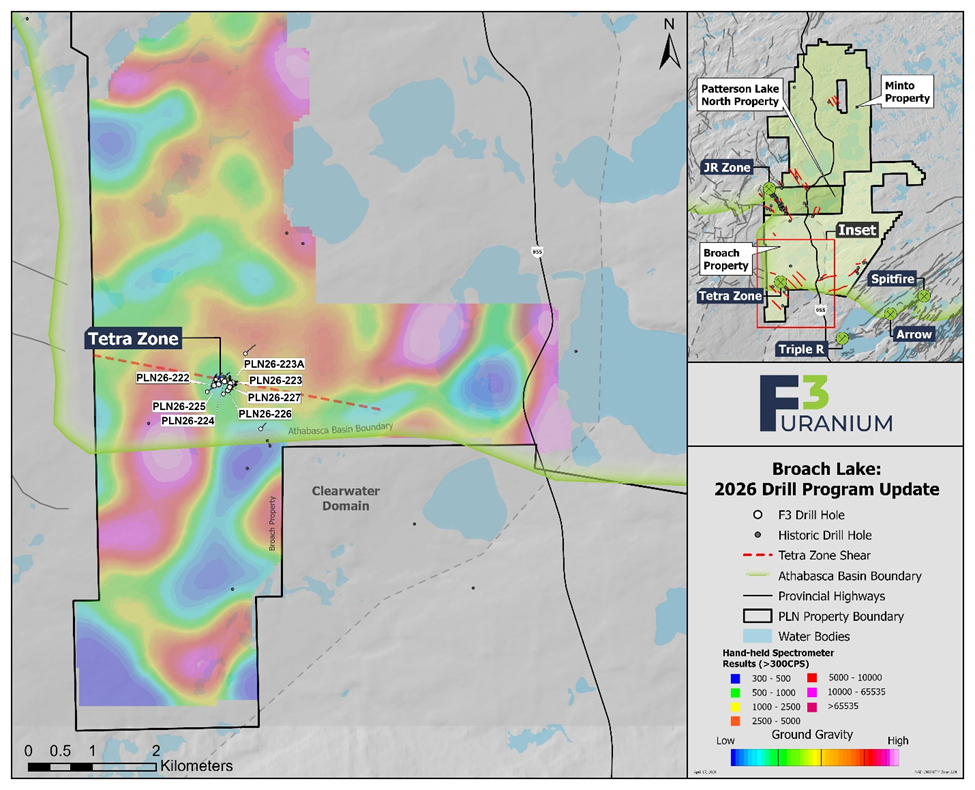
Image 1. Tetra Zone Scintillometer Results – Long Section
The Company further announces, pursuant to its Stock Option Plan and subject to the approval of the TSX Venture Exchange, it has granted an aggregate of 240,000 stock options (the “Options”) to Louis-Carlos Vargas Rocheleau, principal of Connect 4 Marketing Ltd, an investor relations service provider for the Company. The Options are exercisable at a price of $0.20 per common share for a period of five years, expiring on March 27, 2031.
The Options will vest in four equal tranches of 60,000 Options each, as follows: 60,000 Options will vest on June 27, 2026; 60,000 Options will vest on September 27, 2026; 60,000 Options will vest on December 27, 2026; and the remaining 60,000 Options will vest on March 27, 2027.
The natural gamma radiation detected in the drill core, as detailed in this news release, was measured in counts per second (cps) using a handheld Radiation Solutions RS-125 spectrometer which has been calibrated by Radiation Solutions Inc. The Company designates readings exceeding 300 cps on the handheld spectrometer (occasionally referred to as a scintillometer in industry terminology; this stems from historical naming conventions and the shared functionality of detecting gamma radiation between a spectrometer and a scintillometer)—as “anomalous”, readings above 10,000 cps as “highly radioactive”, and readings surpassing 65,535 cps as “off-scale”. However, readers are cautioned that spectrometer or scintillometer measurements often do not directly or consistently correlate with the uranium grades of the rock samples and should be regarded solely as a preliminary indicator of the presence of radioactive materials.
Samples from the drill core are split into half sections on site. Where possible, samples are standardized at 0.5m down-hole intervals. One-half of the split sample is sent to SRC Geoanalytical Laboratories (an SCC ISO/IEC 17025: 2005 Accredited Facility) in Saskatoon, SK while the other half remains on site for reference. Analysis includes a 63 element suite including boron by ICP-OES, uranium by ICP-MS and gold analysis by ICP-OES and/or AAS.
The Company considers uranium mineralization with assay results of greater than 1.0 weight % U3O8 as “high grade” and results greater than 20.0 weight % U3O8 as “ultra-high grade”.
All depth measurements reported are down-hole and true thicknesses are yet to be determined.
About the Patterson Lake North Project:
The Company’s 42,961-hectare 100% owned Patterson Lake North Project (PLN) is located just within the south-western edge of the Athabasca Basin in proximity to Paladin’s Triple R and NexGen Energy’s Arrow high-grade uranium deposits, an area poised to become the next major area of development for new uranium operations in northern Saskatchewan. The PLN Project consists of the 4,074-hectare Patterson Lake North Property hosting the JR Zone Uranium discovery approximately 23km northwest of Paladin’s Triple R deposit, the 19,864-hectare Minto Property, and the 19,022-hectare Broach Property hosting the Tetra Zone, F3’s newest discovery 13km south of the JR Zone. All three properties comprising the PLN Project are accessed by Provincial Highway 955.
Qualified Person:
The technical information in this news release has been prepared in accordance with the Canadian regulatory requirements set out in National Instrument 43-101 and approved on behalf of the company by Raymond Ashley, P.Geo., President & COO of F3 Uranium Corp, a Qualified Person. Mr. Ashley has reviewed and approved the data disclosed.
This news release also refers to neighboring properties in which F3 Uranium has no interest, and the Qualified Person has been unable to verify the information from those properties. Mineralization on those neighboring properties is not necessarily indicative of mineralization on the PLN Project.
For additional information on the PLN Project, including the current mineral resource estimate for F3 Uranium’s JR Zone uranium deposit, please refer to the report titled “NI 43-101 Technical Report, Patterson lake North Project, Northern Saskatchewan, Canada” dated January 20, 2026, available at www.sedarplus.ca.
About F3 Uranium Corp.:
F3 is a uranium exploration company, focusing on the high-grade JR Zone and new Tetra Zone discovery 13km to the south in the PW area on its Patterson Lake North (PLN) Project in the Western Athabasca Basin. F3 currently has 3 properties in the Athabasca Basin: Patterson Lake North, Minto, and Broach. The western side of the Athabasca Basin, Saskatchewan, is home to some of the world’s largest high grade uranium deposits including Paladin’s Triple R project and NexGen’s Arrow project.
Forward-Looking Statements
This news release contains certain forward-looking statements within the meaning of applicable securities laws. All statements that are not historical facts, including without limitation, statements regarding future estimates, plans, programs, forecasts, projections, objectives, assumptions, expectations or beliefs of future performance, including statements regarding the suitability of the Properties for mining exploration, future payments, issuance of shares and work commitment funds, entry into of a definitive option agreement respecting the Properties, are “forward-looking statements.” These forward-looking statements reflect the expectations or beliefs of management of the Company based on information currently available to it. Forward-looking statements are subject to a number of risks and uncertainties, including those detailed from time to time in filings made by the Company with securities regulatory authorities, which may cause actual outcomes to differ materially from those discussed in the forward-looking statements. These factors should be considered carefully and readers are cautioned not to place undue reliance on such forward-looking statements. The forward-looking statements and information contained in this news release are made as of the date hereof and the Company undertakes no obligation to update publicly or revise any forward-looking statements or information, whether as a result of new information, future events or otherwise, unless so required by applicable securities laws.
The TSX Venture Exchange and the Canadian Securities Exchange have not reviewed, approved or disapproved the contents of this press release, and do not accept responsibility for the adequacy or accuracy of this release.
F3 Uranium Corp.
750-1620 Dickson Avenue
Kelowna, BC V1Y9Y2
Contact Information
Investor Relations
Telephone: 778 484 8030
Email: ir@f3uranium.com
ON BEHALF OF THE BOARD
“Dev Randhawa”
Dev Randhawa, CEO